



Many people think that income abroad is automatically taxed only there.
Particularly in the case of activities in Luxembourg or Switzerland, the assumption quickly arises that this income no longer plays a role in Germany.
The reality is much more complex.
A recent ruling by the Federal Fiscal Court shows that in certain constellations, even remuneration components treated as tax-free abroad can be taxable in Germany.
When is income abroad really tax-free?
Whether foreign income is tax-free depends primarily on so-called double taxation agreements.
These regulate which state may tax your income.
In many cases:
If you work abroad, the country of employment often has the right of taxation (depending on the DTA and individual case, e.g. also depending on the days of stay/work and the employer). Germany then typically exempts such income and only takes it into account in the progression proviso.
This means that your income remains tax-free, but increases your tax rate.
However, there is one crucial point that is often overlooked.
The critical point: tax-free income abroad
It always becomes problematic if your income abroad is fully or partially tax-free.
In such cases, the DTA exemption may be restricted under national law (keyword: reversion/subject-to-tax clause, e.g. Section 50d (9) sentence 4 EStG).
The background is simple:
The background to this is the aim of avoiding double non-taxation. However, whether Germany is actually allowed to tax depends on the specific DTA regulation and the interpretation of the national reversion clauses.
If a country waives taxation or gives tax concessions to individual components, Germany can still tax them, depending on the DTA regulations and national law.
Federal Fiscal Court ruling: Why the case is so important
The Federal Fiscal Court had to deal with a case from Luxembourg in summary proceedings on the suspension of enforcement in its ruling dated 04.03.2026 (case no. VI B 44/25 (AdV)).
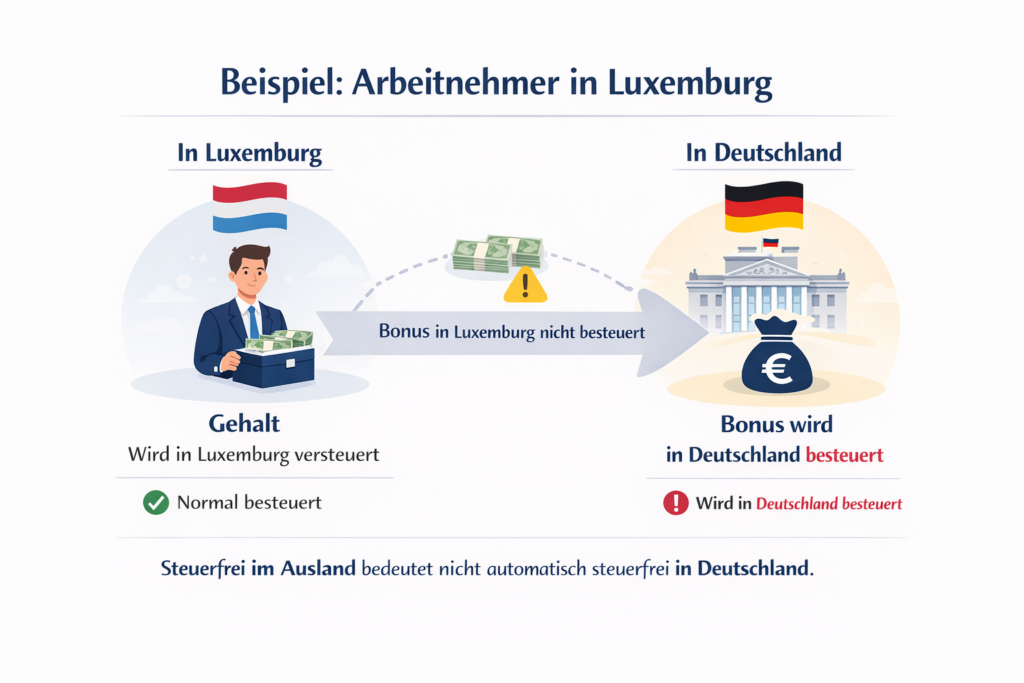
One employee received a participation bonus in addition to his salary, which was partially tax-free.
The German tax office treated precisely this tax-free portion as taxable in Germany.
The BFH did not make a final decision on the main issue at this stage of the proceedings. However, it considered the legal question to be open and “seriously doubtful” in terms of content
The question of when individual income must be taxed in Germany has not yet been conclusively clarified.
For taxpayers, this means one thing above all:
Legal uncertainty and high risk of incorrect classification.
Typical practical cases in which Germany intervenes
In practice, this mainly concerns situations in which remuneration components are not taxed in whole or in part in the country of employment or the place/period of employment has to be split:
-If you receive special payments or bonuses that are favored abroad
If you work abroad but part of your income is tax-free or tax-privileged there
This quickly becomes complex, especially with international business models or hybrid forms of work.

Common mistakes with foreign income
Many people assume that tax-free abroad automatically means tax-free in Germany.
Another common mistake is the lack of documentation of working days and work locations.
Without this evidence, the tax office can quickly make its own assumptions that lead to a higher tax burden.
Why splitting your income is crucial
A central point is the exact allocation of your income.
The decisive factor is always:
Where was the service provided
Which part of your income belongs to which country
The more precise this allocation is, the lower the risk of unexpected taxation in Germany.
For whom this topic is particularly important
The current development affects significantly more people than before.
It is particularly relevant for entrepreneurs with international structures, cross-border commuters, freelancers and consultants, influencers and employees working abroad.
Conclusion: Tax-free abroad is not a sure-fire success
The proceedings before the Federal Fiscal Court show: Exemption under a DTA is not automatic – especially not if individual components remain tax-exempt in the country of activity or if preferential treatment applies.
Tax-free abroad does not automatically mean tax-free in Germany.
Anyone who operates internationally should have their tax situation carefully examined.
This is because, particularly in complex cases, it is necessary to check exactly which state is allowed to tax.
Why professional advice is crucial here
International tax issues are among the most complex areas of tax law.
Standard solutions usually fall short here.
At Taxboutique, the focus is precisely on such cases.